
Governing Drift: When the Docs and Reality Disagree
For a lean group running several companies on shared systems, drift between the code, what is live, and the docs is a liability. Here is the governance we built: one source of truth, contracts inside the docs, drift reconcilers, and a monitor that texts us when reality and the record disagree.

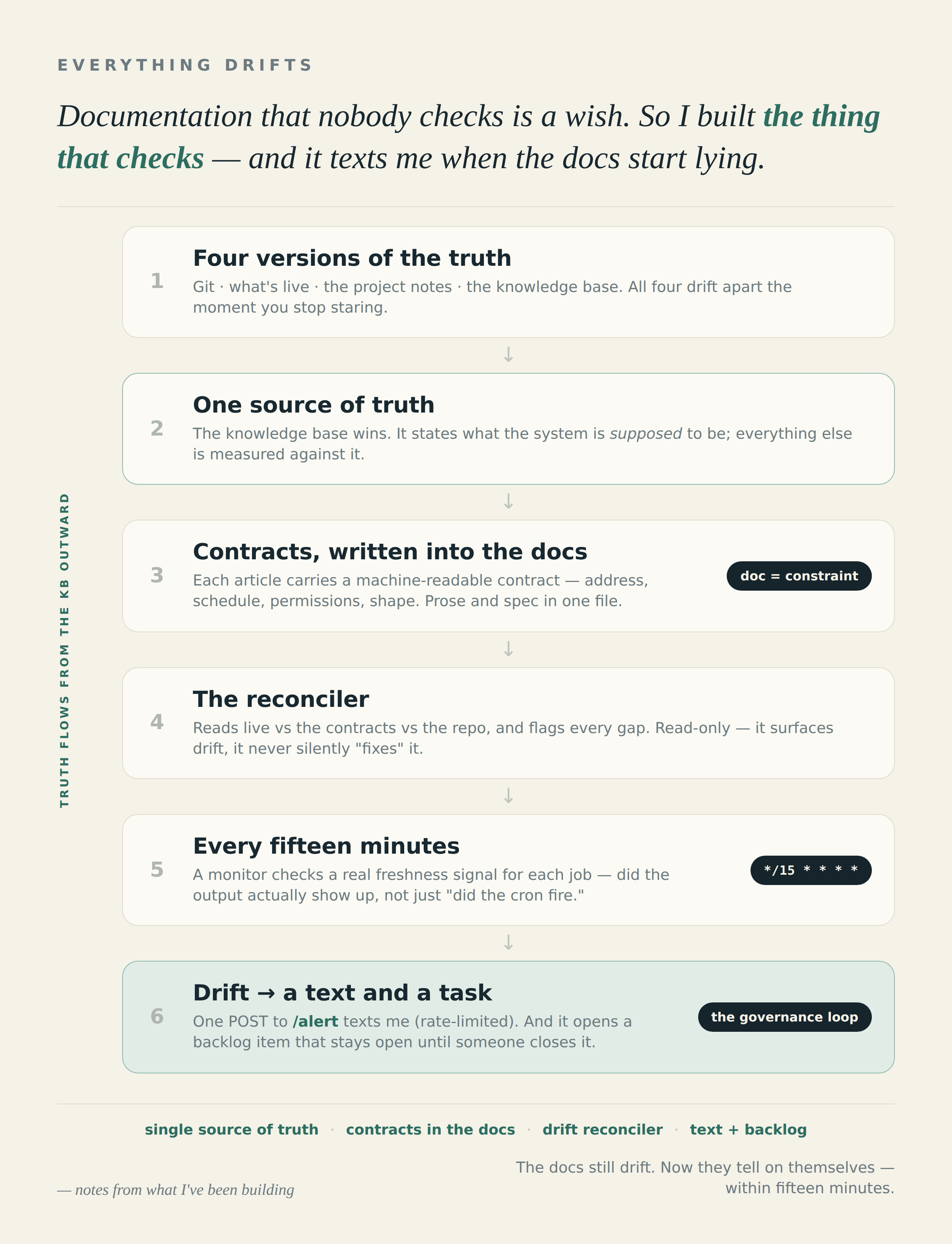
Every system that stays alive long enough starts lying to you. Not on purpose — it drifts. What is in the code, what is actually running, the working notes, and the official documentation become four different pictures of the same operation, and they wander apart the moment nobody is watching. For a lean group running several companies on shared systems, that drift is not a nuisance. It is a liability. So we governed it.
One source of truth
You cannot keep four representations in sync by willpower, so we picked a winner. The knowledge base became the single source of truth — the authoritative statement of what each system is supposed to be. Everything else is measured against it, and a disagreement is treated as a signal that something has drifted, not as a reason to doubt the source.
Contracts, and workers that watch
Each system carries a machine-readable contract inside its knowledge-base article — address, schedule, permissions, shape — so the documentation and the specification are the same file and cannot drift apart. Then a reconciler reads what is actually live, what the contracts require, and what the operator overview claims, and flags every gap. It is read-only; it surfaces drift rather than silently correcting it, because a silent fix is how a real problem gets buried. A separate monitor runs every fifteen minutes, checks whether each critical job actually produced its output, and on staleness or drift sends a text message and opens a task — so nothing falls off the edge quietly.
Governance as an operating discipline
Drift findings and ordinary work land in the same governed backlog — what broke and what is left to build, tracked together, in the open, each with an owner. That is what governance looks like when it is real: not a binder on a shelf, but a loop that runs on a timer and interrupts a human the moment reality and the record disagree. We run it because our customers inherit the consequences of systems that quietly drift, and we would rather the system tell on itself than have a customer discover the gap for us.
The full technical write-up lives on jessemyers.ai.